On the Guardian books blog, Andrew Gallix ponders Spam Lit and its literary forebears. The 3AM buzzwords blog has reposted the article entitling it Scriptures from the future, a phrase used by spam poet, Ben Myers. Gallix's article is a fascinating piece, not least because of the rich hyperlinks he has left for the reader to follow. Follow them is what I did. As I did, one word, "random" and its essence, "meaninglessness" kept on popping up. Here's a selection:
Disassociated press: "an algorithm for generating text based on another text. It is intended for transforming any text into potentially humorous garbage. [...] The algorithm starts by printing any N consecutive words (or letters) in the text. Then at every step it searches for any random occurrence in the original text..."
Word salad: "Word salad is a mixture of seemingly meaningful words that together signify nothing." Spammers for instance add "large amounts of random text somewhere in their message" in the hopes of getting through filters.
Markov chain: "An example of a Markov chain is a simple random walk where the state space is a set of vertices of a graph and the transition steps involve moving to any of the neighbors of the current vertex with equal probability (regardless of the history of the walk)."
Spoetry: "Here, perhaps, is the new poetry of the 21st century, a reinvention of language that pushes the cut-up technique of William Burroughs or the randomly generated 'liquid writing' of Jeff Noon's Cobralingus."
Automatic writing/drawing: "In automatic drawing, the hand is allowed to move 'randomly' across the paper. In applying chance and accident to mark-making, drawing is to a large extent freed of rational control."
Cut-up technique: "The cut-up technique, also known as fishbowling, is an aleatory literary technique or genre in which a text is cut up at random and rearranged to create a new text."
Aleatory literary technique: "Aleatory means "pertaining to luck", and derives from the Latin word alea, the rolling of dice. Aleatoric, indeterminate, or chance art is that which exploits the principle of randomness."
Such randomness has strong connotations to the evolutionary theory of random mutations. Nevertheless, in all the above literary cases, the random element is subsequently exposed to an intense process of editing, i.e., the process of creating something out of "nothing", which brings in the God element. But then again, all the random elements above themselves are instigated by writer/programmer/spammer in question. The random rather is a result of a purposeful, creative energy desiring to see what can be achieved.
The flow thus goes: creator:random state:editor. In some cases creator and editor will be the same person, in others different people. Sometimes it is the creator that sets off the random state, other times the editor. That new things are created via the random state however, is the mystery. The mystery itself is hidden within the text, asking to be sought out, but always hiding in the random state.
Friday, 4 July 2008
random scripture?
Friday, 6 June 2008
the medium is the mash-up
According to Will Self, via the 3AM blog via a BBC magazine article, "the computer user does their thinking on the screen, and the non-computer user is compelled, because he or she has to retype a whole text, to do a lot more thinking in the head."
This comment was made in relation to writers continuing to use typewriters. In fact the BBC story headline reads "Why typewriters beat computers". Which is true, but then computers beat typewriters, and pens beat computers and pencils top pens. It's the old Mcluhanism at work - the medium is the message, and each medium brings something to the message that another medium doesn't. So the mashed prophet is not going to get worked up about what is the superior medium. What is pertinent for this blog is Will Self's comment in relation to textual mash-ups.
If you're old enough to remember when CD's first appeared, they made a big hoo-haa on the CD sleeves about which particular recording technique was used. AAD, ADD, DDD and so on, in which A stood for analogue and D for digital, with each letter standing for the corresponding step in the recording process.
I've often thought of this system in relation to writing mash-ups, because I can choose how I am going to record it. Most often I like to retype the texts that I am going to be mashing instead of say copying and pasting from an online source. That would give the process an analogue element. Sometimes I'm lazy, or what I want to use is too long, so I just copy and paste. Sometimes I work on paper and then transfer it to the computer screen. Maybe, one day in the future, I'll buy a typewriter and use that as well just for fun. But whether I'm thinking on the screen, or thinking in my head, using a non-destructive editing process that the computer screen offers me, or a destructive editing process that a pen and a piece of paper offers me (and maybe in the future a typewriter), the writing process remains beautifully mysterious, allowing for the strengths and weaknesses of the medium in which writing records itself to incarnate the Word.
Wednesday, 4 June 2008
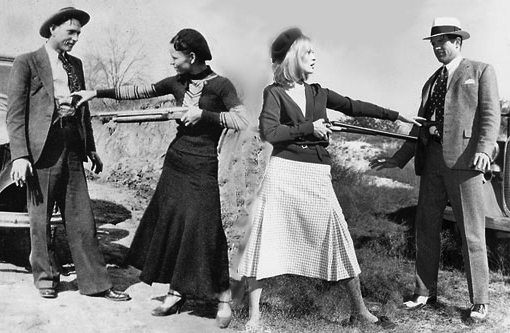
Bonney & Swift, aka Bonnie & Clyde.
Shirley Dent, on the Guardian Books blog reports of a blogosphere spat between Bonney and Swift in which she notes that Swift,
taking his cue from Madonna, "strikes a pose" in postmodernist style (is it me or does Madonna seem omnipresent in discussions about postmodernism?), arguing for "a genuinely radical postmodern poetics". This involves breaking formal barriers, requisitioning pop-culture techniques such as "mash-up" and using then to produce a postmodern poetry that gives us "resistance-as-fun".
What the mashed_prophet likes about Swift's thinking on Eyewear is the notion of the mash-up being a resistance strategy to capitalism:
"Olsen's essay resists some of the more perplexing ambiguities circulating around current questions of entertainment, and digital media (including piracy), in the global arena: that is, people no longer interact with even capitalist-created cultural product passively. They mash-up and mix music - they alter it - engaged, as readers, with the text. Some of these activities (copyleft and further) can hardly be categorised as anything but anti-capitalist. It might be hard for a British linguistically innovative poet to say so, but elements of popular culture are fun, can be ironically and politically transformed by engagegement with their discourse(s)."
Mashed_prophet, being linguistically innovative, has no problem agreeing with this.